
What Exactly IS Compliance Monitoring and Why Do We Do It?
As per the Individuals with Disabilities Education Act (IDEA) and State Board of Education regulations, each state must ensure that all students with disabilities receive a ”free appropriate public education” (FAPE) program as well as need-based special education and related services. Each state must also confirm that students’ families are aware of procedural safeguards or protected educational rights during the evaluation and Individualized Education Program (IEP) process.
The compliance monitoring process verifies that schools and agencies serving students with disabilities adhere to appropriate timelines, programmatic instruction, state indicators, and parental involvement requirements.
The Monitoring Process: From Notification to Rectification
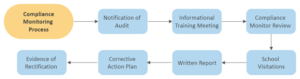
While this process may vary by state, compliance monitoring’s purpose is the same anywhere nationwide: to establish compliance with the IDEA and state regulations.
Throughout my professional experience as a Special Education Director, I regularly participated in focused and cyclical monitoring to determine compliance. For reenactment’s sake, let’s examine the steps in Pennsylvania’s compliance monitoring process:
Step One: Notification & Training
Initially, my district would receive a notification that an audit would occur in the current school year. When this happened, our special education administrative staff members would attend a required informational training meeting regarding the auditing process and procedures conducted by the state’s compliance division.
Step Two: Compliance Monitor Review
Post-training, my district would receive a list of the student files that would be reviewed. This list was compiled from the district’s student data via the state’s special education accounting program. We would also receive a compliance website link to supply preliminary information based on various questions about student file information and district policies, procedures, and personnel.
Step Three: School Visitations
Next, appointed personnel would visit school sites over several days. The staff would review the identified student files, observe school programs, and interview teachers, parents, and district administration. The process required a high level of detailed documentation to verify compliance–or a lack thereof—and could be tedious and stressful.
Step Four: Corrective Actions & Rectification
Lastly, the documentation culminated into a written report featuring the district’s successes and necessary corrective actions for identified violations. Subsequently, the district was expected to develop a corrective action plan and provide evidence to the state confirming the rectification of the identified concerns.
How do you prepare for a compliance audit? Find out here!
Does your school or district need assistance with compliance monitoring or audit preparation? I can help! Reach out to me through this form or via email at ageissel@txsource.com.