
Schools began the 2022-2023 academic year nationwide with high expectations. However, many schools are currently facing a new challenge: teacher shortages.
According to the National Education Association, schools faced a shortage of 300,000 teachers and staff across the United States in August 2022. News outlets reported that these openings were at crisis levels, and parents were increasingly concerned about how this new crisis will affect their children’s education. After all, many of these children were already academically behind because of the pandemic.
However, not all teacher shortages are a symptom of COVID-19. Instead, the pandemic exacerbated a problem that has been ongoing for years. To fully understand the crisis, it’s essential to delve into the background information of this issue to develop long-lasting resolutions.
What Causes Teacher Shortages?
Randy Weingarten, president of the educators’ union American Federation of Teachers, attributed teacher shortages to the nation’s political climate combined with COVID-19’s effects. Other experts agreed with Weingarten’s assessment but added that many teachers are experiencing burnout and exhaustion.
These factors – along with low pay, a general lack of respect for the teaching profession, district policies, and various state laws – contributed to teacher shortages.
Another contributor is the decrease in student enrollment in teacher education programs within the higher education sector, supported by startling longitudinal data. Over the last ten years, there has been a 35 percent decline in college students earning degrees in education.
Further analysis reveals that some states saw a 45 percent teacher enrollment drop while others experienced a 70 percent decline. Given these grim statistics, we can deduce that schools have had difficulty identifying and recruiting new teachers to fill these vacancies.
So, the question is: why aren’t individuals entering the education profession? It can be presumed that when contemplating which career to choose, potential teacher candidates are reevaluating whether education is the ideal profession to enter. Issues such as the pandemic’s lasting effects and second-rate working conditions have deterred many from considering a teaching career.
How Serious Are the Teacher Shortages?
Essentially, the brief answer to this question varies depending on who you speak with and where you live. A Learning Policy Institute study states the following:
“Teacher shortages are not felt uniformly across all communities and classrooms, but instead affect some states, subject areas, and student populations more than others, based on differences in wages, working conditions, concentrations of teacher preparation institutions as well as a wide range of policies that influence recruitment and retention.”
At the state level, wages, working conditions, and attrition rates vary from state to state. Coupled with policy differences, these disparities have created a variation in the number of job openings, making it difficult to ascertain the actual teacher shortage percentage at the state level.
When examining the district and school level more closely, officials indicate that the need for historically hard-to-fill positions, such as special education, math, science, and English Language Learner teacher roles, has increased. Additionally, special education-related services and elementary education job openings have grown substantially.
Also, schools with high-poverty and high-minority populations have historically experienced the most significant number of teacher shortages, which has disproportionately impacted the achievement of our most disadvantaged students. With not enough teachers to go around, it stands to reason that the schools viewed by candidates as having the least desirable working conditions and resources are the schools with the most job vacancies.
How Do We Address the Issue of Teacher Shortages?
First, let’s start by stating that there is no “silver bullet” to rectify the situation. Many administrators face challenges while adapting to the current situation and feel pressured to fill classroom positions. Faced with the challenge of having no educators to work with students, officials are implementing strategies, such as utilizing teachers who are certified in discipline areas that differ from what they are teaching.
For example, I’m aware of several schools using elementary education-certified teachers to teach special needs students—not surprisingly, neither the students nor the teacher benefits from this. Elsewhere, some schools are employing partially certified individuals to cover classes. Some school districts are offering hiring bonuses or paying for relocation expenses. Additionally, many states are relaxing their certification standards to make it easier to recruit candidates.
While it’s true that short-term solutions may temporarily curb the fear of empty classrooms, they can also exacerbate the problem in the long run. For example, if administrators hire teachers who aren’t fully prepared, there is a high probability of turnover. Ultimately, turnover proves costly in terms of money spent on the teacher replacement process and a decrease in student achievement.
To implement effective, long-lasting solutions, administrators must develop policies to increase interest in a teaching career path.
How Do We Attract More Candidates to the Teaching Profession?
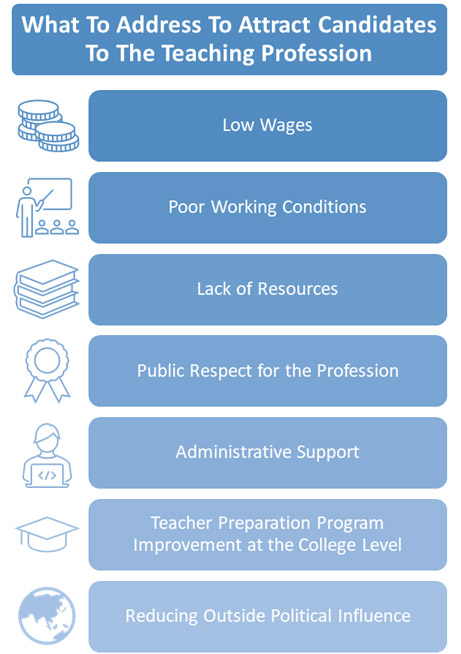
To attract potential candidates to the teaching profession, we must design policies to address the following:
- Low wages
- Poor working conditions
- Lack of resources
- Public respect for the profession
- Administrative support
- Teacher preparation program improvement at the college level
In the meantime, as we resolve this problem, we should consider virtual education usage and assistance from staffing organizations, such as Therapy Source, to help with finding personnel. School volunteers could also provide additional support to the classroom’s teachers and students.
Administrators may wish to review class schedules, school policies, and procedures that add to teacher workloads. Developing a mentoring program for inexperienced teachers may help with staff retention and ongoing support. Ideally, as resolutions are brought forth by all parties, the teaching profession will attract more students, and schools will retain those already employed.
We must focus on long-term solutions if we genuinely value our educational system. Following this course of action will not only allow for recruitment and retention. It will also relieve the teacher shortage and produce a strong teacher workforce that prioritizes student education by highly-qualified individuals.